My 2 Week Personalized Learning Adventure

25 years.  Nearly a quarter century.  I have worked in education and within my single school district for more than half of my life.  Goodness.  And while I may not be able to explain just how I made it this far, how I stayed afloat through all the tough times, and how I stayed away from burnout and boredom, I do know that if you don’t continue to try things, to experiment, and to commit to remaining a learner, then you surely won’t make it.

Each of the last several years we have been given two consecutive weeks of professional development (PD) time with our faculty.  Now at first glance, you might believe that to be wonderful and such a welcome gift from the school gods.  However, I have learned that, as educators, we do much better with kids around.  Two solid weeks of only adults on campus can be taxing.  The energy, the zeal, and the urgency aren’t there when kids are not present.  We need them as much as they need us. The flip side is that designing two weeks of learning for your teachers that is not full of sitting in the cafeteria/auditorium/multi-purpose room and seeming like yet another meeting, can be daunting.  As the Principal, I have to remember that teachers want to move in, work with their teams, and prepare for the first day of school.  I have to give them that time. With all of that in mind, and as June headed in to July, I began to focus on planning PD for my 190 teachers.  I sharpened my focus on how to move from structured to personalized professional development.

Death bu Inservice

So this is my 5th year as campus principal and 9th year on campus.  I have a strong understanding of my faculty and staff, and thus I wanted to try something different.  Simultaneously I wanted to create a setting whereby they re-engaged as learners while also respecting them as professionals.  I wanted to model choice and creativity and exploration.  Crafted similar to a conference format, I aspired to build something I had not, personally, ever experienced.  This was critical to me as I believe that these very elements, when put in to practice within our classrooms, lead to more authentic engagement by our students.

In a nutshell this was my plan.

During the first of our two weeks, I included all the usual stuff: a welcome back presentation from me, time for PLCs and Departments to meet, and devoted moments for everyone to complete the required online district trainings.  However this year I gave them a learning menu in the form of a Tic-Tac-Toe board that had new experiences as the nine blocks.

Tic Tac Toe Board

  • Chit Chats are 25-30 minute gatherings around a central topic or question.  Each of these Chit Chats was scheduled for six over the two weeks.  There was no formal presentation and each person could attend if they choose.  If the topic didn’t appeal to them then don’t come.  Keep working with your teams or on your own planning.  The Chit Chats were organic and I merely brought the food.  Cookies in the afternoon, donuts in the morning, and fruit for the mid-morning session.
  • Make & Take sessions are focus on a single strategy, skill, or tool.  These 45 minute sessions provided a forum for you to learn something specific that you could immediately incorporate in to a specific lesson (or simply in to your classroom).  I offered ten of these sessions during the two weeks of PD.
  • A Learning Lunch is centered on a larger question.  Both Wednesdays included these with the understanding that everyone brought their own food, and that we would sit in a giant circle.  While I opened each session with a reminder of the general question, and affirmed that participation is completely voluntary, it was not uncommon for me to stay silent the rest of the time as the teachers drove the discussion, and thus their learning.

The common threads among each of these three events begins with the fact that they were elective learning opportunities.  If someone wanted to learn about the topic – whether by actively participating or merely lurking – then they could do so.  Most of the sessions were not formally led by me or anyone from my leadership team.   Finally, each of these new experiences were chances for them to elect to learn.  That was the key in my mind.  Providing the setting for them to experience choice and then make a decision.  Now the Tic-Tac-Toe board could be turned in for prize drawings – if they choose to do that.  There were no signatures required as this was not any type of compliance piece.  Teachers are professionals and I wanted my faculty to feel that in an overt way.

I also asked teachers to join our faculty/staff Remind group and I used electronic communication to remind them of upcoming learning sessions that would be available. Joining our 11 day Twitter Challenge was also an option.  Finally, the center block  of the Tic-Tac-Toe board was each of them signing up and participating with a team during a BreakoutEDU session.

A large part of my learning in this adventure included a deep dive in to so many digital tools.  Making use of Google Docs, Remind, and Google Forms (to gather feedback & add topics over the two weeks) allowed me to communicate in a manner I couldn’t have before the technology.  My agenda was not a static document – I was able to change and adjust.  Agility was on display and that also was an approach I wanted to model for my faculty.

Jumper

I don’t yet know how it is being received or how effective it will end up being.  And I’m a little nervous about that.  Similar to my most recent blog post My Attempt at #GeniusHour with Adults, we have asked all of our teachers to choose something they want to learn about this semester or school year.  Now it may not completely meet the district expectations and I’m probably taking a bit of a gamble with that.  However I do believe it is the right approach THIS year with THIS faculty.  I now know that choosing to be a learner – whether your 1st year or 40th year as an educator – is critical to each of us staying relevant for our teams and, most importantly, for our students.

What types of behavior are you modeling for your teachers as the start of school approaches?

My Attempt at #GeniusHour with Adults

I have been a secondary principal for half of my education career – 12 out of 24 years.  Starting this fall, I will have been in the main chair more than I was anywhere else.  And so as I enter this off-season and reflect on the past school year, I can honestly say that I pushed myself in a new way.  You see, I was starting to get a bit stale.  Yes, I still was intensely challenged, and the commitment to my campus, its students, faculty, staff, and community, had not wavered.  I simply wasn’t sure what was missing.  And thus, I spent this past school year trying to figure out what I was trying to figure out.

1

Twelve months ago I entered the summer focused on the idea of becoming a learner again.  I juiced up my iPad, downloaded some great books, and read a lot.  The focus of what I consumed relied upon Twitter, and thus I resuscitated my twitter handle and committed to jump back into the learning.  I was excited.  I ate up articles, retweeted prolifically, and tried to spark wonderful conversation.  My followers grew slowly and my notifications were few.  I didn’t feel like I was gaining traction.  And so when the start of the new year came, it was easy to “get busy with school.”

In October I attended the What Great Educators Do Differently Conference in Chicago with two friends.  I was inspired and my learning engine was reignited.  This idea of discovery and sharing and pushing myself was exactly what I needed.  And as the conference closed, I kept hearing people mention #GeniusHour.  I didn’t know what it was, and, honestly, I was afraid to ask.  I nodded my head and figured it was something I could research later.

A few weeks later, I revisited my notes from the conference, and came across the term – #GeniusHour – again.  I decided to google it.  And as I perused the first website, and then the second, and then the third, I became energized again.  My thoughts raced from, “sure this can work in ES or MS, but what could it look like in the content-obsessed world of high school.”  And then the light bulb went off.

I spent the next two weeks constructing a #GeniusHour presentation for my administrative team.  I then presented to the 12 of them the idea of #GeniusHour followed by the challenge that would come their way.  I told them that we were each going to embark on this work and purely learn.  Topics could be related to school or education, or they could be something more personal.

GeniusHour Final

The room was silent.

A few members of my team had smiles as they knew what they were going to do.  Others had clarifying questions – perfectly acceptable.  And others basically kept their heads down.

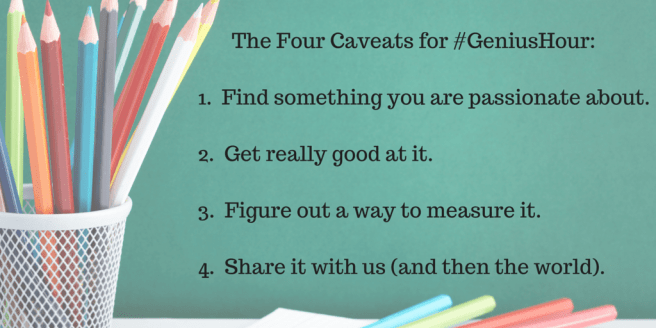
I told them that they didn’t have to seek my approval.  That I was happy to support or be available as they wished.  I was specific enough to keep repeating the 4 caveats yet vague enough to make some restless.  And I was okay with that.

That was in late November.  In May and early June we took turns presenting our #GeniusHour projects.  What emerged has exceeded my expectations.  The topics ranged from learning a new language, to a DIY project; others focused on starting a blog while another was writing a novel with his son.  Two projects centered on relationships with one focused on just adults and the other on adults and students.  Finally, one teammate shared her journey from an inactive lifestyle to completing the Texas Ironman Triathlon.

And as we debriefed each presentation the common challenges of being a learner surfaced.  The uncomfortable feeling of starting something you weren’t certain you would understand or be good at.  The idea of learning taking longer or shorter than expected.  The focus on the outcome as opposed to the minutiae.  They had all reengaged as learners.  They also spoke about what it could look like in the classroom and how they might better support both teachers and students.

Prepared to be wrong

This #GeniusHour work that we embarked on will lead much of what we do in August with our entire team.  It wasn’t perfect – two members of my team chose not to participate.  And I had to come to terms with that as being okay.  They may not have felt safe or merely weren’t ready to reenter that space.  The remaining ten that did will share their learning with smaller groups on campus.  We will support our teachers in becoming a learner again.  Maybe their topic will center on an idea for their classroom or maybe it will be more personal.  Frankly, I don’t think the topic matters at all.  It’s the process that will count more.  It’s the experience that will stick with them as they move through the school year.

I didn’t know how it would go with my team, and I don’t know how it will go trying to scale it up with 185 teachers.  However I was certain that we needed a fresh challenge to jump start our work, and I’m counting on that same energy to launch our faculty forward as well.  If we don’t try then we’ll never know.

In my best case outcome, I see teachers embracing this challenge.  And I see them more able to empathize with the challenges of learning.  Each teacher will see that different learning styles exist, and that timelines and modes of sharing can enhance and empower the content they hold so dear.  Additionally, their students will no longer see themselves as the only ones taking a risk.  It’s increasing humanity on campus.  Genuine vulnerability in an intimate way.  Maybe it will help a student persevere a bit more, give it a go one more time.  We will see.

How have you recently engaged as a learner? How could you facilitate a #GeniusHour with the people that work alongside you?


Favorite Day of the Year: High School Graduation


BHS GRADUATIONThe last weekend in May is often a fond time for high school principals.  While some welcome the end of another school year and the “off-season” that comes with June, it is the actual commencement exercises that I enjoy the most.  It is, maybe, the singular day where everyone is happy.  The students walking across the stage have all achieved whatever is needed and thus they are pleased.  Parents have only two requirements for the event – make sure their child’s name is in the program and be sure to announce their name.  That’s it.  So they are delighted.  It’s a great day.

Now for me it is also a workout as I shake the hands of more than 800 graduates and smile for individual pictures with each of them.  While it is a grind, the graduation allows me to have a personal moment with each of them before they head forward.  I hope to never take that for granted.

I also have the charge of sharing a few words of wisdom, and that is a practice that I take seriously.  It is a chance to convey to both students and parents what is important to you, and thus the school.  It’s a chance to reward them for their faith and trust in public education and remind them that you have their best interest at heart.  For this annual speech in front of nearly 10,000 people, I often use some form of a common script.  However this year was different, this class more unique, and thus I pushed myself.  Below is what I shared and I hope that others may find it helpful.

“The scars on my skin are a map of the adventures and the places I’ve been.”

-U Li La Lu, poi dog pondering

Map of Adventures

Having the honor to stand before you and offer a few words as you move forward is a highlight for me.  My pride in your accomplishments is boundless.  Among many highlights, this class led us to our first Football Playoff Victory in 43 years, you won National Championships in a variety of competitions, you’ve been offered scholarship dollars that exceed $36 Million (by the way this is nearly $15 Million more than our previous record); you’ve entertained others across the country, and you’ve comforted each other through the toughest challenges anyone might face.  We laughed and celebrated while we cried and grieved.  There was no obstacle put before us that we could not overcome.

Now this is the part of my speech where I normally challenge you to live your life with great wisdom while offering some sage advice.  However this year, as has been referenced, is different.  You see, this year I learned from you.

I learned what it means to be part of a community.  I watched as over four years together you each accepted each other regardless of background, race, economic status, gender identity, or any of the other means by which we too often get categorized.  You refrained from falling in to the stereotypes that so many try to paint upon your generation.  While you embraced the typical high school experiences such as Homecoming, student concerts and athletic events, and, of course, Prom, you also found moments to bring people and resources together for a greater purpose.  Being part of a community is similar to being part of a family.  And it’s important to remember that family members agree and disagree, they hug and cry, they share the grandest of laughs while embracing through the lowest moments of sorrow.  And then they recover.  It may not always be pretty and it can get messy, however it is absolutely what every family experiences and exactly what needs to happen.

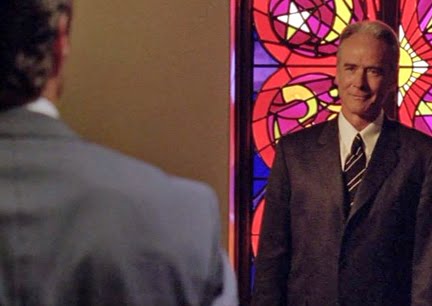
Now I was and remain a fan of a TV show called LOST.  And while making every effort to not give anything away, there is a great quote delivered in the series finale that I think particularly fits this senior class, and I’d like to share it.

LOST Speech no words

This is a place that you all made together so that you could find one another. The most important part of your life was the time that you spent with these people on that island. That’s why all of you are here. Nobody does it alone. You needed all of them, and they needed you.

While these past four years were both not fiction and not an episode of Survivor, the school you entered in 9th grade was what was necessary then.  And for the years that followed you sacrificed, you invested in yourself, and you built exactly what was required.  Together you created this senior year because it was what you needed.  And a few months ago – when we lost Jade & Michael – together you made your way through it.  Because you had to and because you could.

Now the worry that often creeps in for seniors at this time is what happens next.  Maybe you will want your community to mirror what it is now.  Or perhaps you will desire something completely different.  My wisdom for you is that because of the experience you had at Bellaire, you, more than most of your peers across the city, state, and country, are truly prepared to build your own community.  Because you have already experienced it, if you can truly commit to do it, then what results from your effort will be exactly what you require.  You have that within you.  Trust it.

So as you prepare for the next exciting adventure in your life treasure the time you have had together.  Many of you will move on to the same college or city, and the effort needed to maintain friendships in this technologically rich world is far less than it was for your parents and me.  Yet it still requires effort, it demands respect, and it starts with a shared experience.  As your principal these past four years, I am confident that the shared experience of having moved through Bellaire is one that has been powerful for you.  I am humbled by your success and I thank you for always sustaining the necessary effort.  Go forward from today and lead a life that you take pride in, that you respect, and that you value.  Also be sure to eat your veggies, apply sunscreen, Stay Classy, Live Long and Prosper, and, finally, May the Force Be With You.

Understanding that the Principal has the opportunity to offer the final sentiments to students before they leave your school, how do you approach this opportunity?  What words of wisdom do you share?


Who Doesn’t Like a Lollipop?

Working on a High School campus has been my good fortune for more than fifteen years.  And in about a month I will graduate my 7th class of seniors as a HS principal.  And thus May is often filled with reflection and nostalgia and opportunities to try and be wise.  Those chances can be inspiring and they can be daunting.  And maybe even paralyzing.  However, while I often welcome these last few weeks with a myriad of emotions, I also want to be sure that seniors make the most of their remaining days together.  The closure associated with High School graduation is powerful.  I don’t want them to miss that.

During the senior class meeting a couple weeks ago, I decided to challenge our seniors and how they might want to make the most of their remaining 28 days on campus.  We talked about how a school works best when there is a strong student culture.  Similar to working with adults, I have learned that paying attention to student culture is equally important.

And after stumbling through some words of inspiration, focusing on the type of legacy they might want to leave behind, I showed them the Lollipop TED Talk by Drew Dudley.  You can access the six minute video just below.  It’s focused on everyday leadership.

I believe this video is the perfect message to send seniors as they plan to embark on that next adventure.  Leadership exists in small moments shared between ordinary people on a day like most any other day.  The mistake we commit is that we too often focus on those large moments.  And while those certainly can include instances of true leadership, I would join Drew Dudley in his call to action that we recognize the more tiny and simple acts.

National Teacher Appreciation Week is beginning and thus this concept can easily translate to acts of recognition and gratitude.  The point is that we allow ourselves to be in the moment with another person and then not miss the chance to simply say thank you.  Perhaps it is a hand-written note.  Or maybe it’s a group of people enjoying an ice cream sandwich together.  Or maybe it’s the exchange of a simple lollipop.

lollipop

My takeaway for you would be that it doesn’t matter if it is adult to adult, or adult to student.  Let’s commit this week, this month, and this year to not miss the lollipop moments that surround us.  Who will you offer a lollipop to this week?


Be Loud & Be Proud

Not long ago I had the chance to hear Joe Sanfelippo talk about how each school must be willing to tell their story.  I’ve heard Joe share this discussion more than once and each time I take something different away from it.  That’s how it usually is, right?  Like a great book or movie, we learn something new with each experience.  Now I want to focus on one particular communication tool we have used for the past 5 years and I’m hopeful it can be of value to other schools either now or for the coming school year.  This event helps us tell our story and we call it Cardinal Kickoff.  The premise centers on the idea that we want to open our doors and show you everything that makes us #CardinalProud.

The description that follows is not a prescription or recipe, rather an example of how a school can take assets that already exist and organize them in a purposeful manner.

TYS Big

Cardinal Kickoff begins with parents arriving and finding our advanced guitar students playing in the auditorium foyer.  And as families grab a program and find a seat, there is a PowerPoint playing with pictures and quick facts cycling and a small string quartet sharing a few pieces.  This large group general session involves a 30 minute presentation focusing on the academic life, the means by which we communicate, and the various ways that kids can get involved on campus.  It’s mostly me talking with some short mixed media pieces to help inform.  The session ends with an introduction to the spirit within our school as led by our Cheerleaders.  As they teach the Color Shout to our future Cardinals you can feel the energy begin to climb within the room.  What follows is my favorite part.

Cardinal Kickoff Big

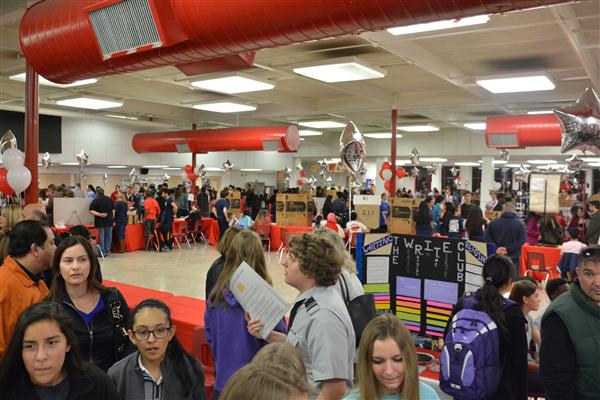
Students and families head to the cafeteria down hallways flanked with our jazz band playing.  And as a little pep enters your step, students can begin to see and hear the buzz inside.  Filling every corner of this large space are tables packed with posters, treats, memorabilia, and sign-up sheets. The room is filled with electricity powered by current students who are recruiting with the same zeal as a basketball scout that has just found the next Lebron James.  Prospective families make their way through the crowds, moving past the Robotics booth to the South Asian Student Union.  They grab a cookie from the Baking Club and enjoy the Anime Club videos.  Music blasts from a corner area with eMotions dancers in a freestyle break-dance session.  Finally they cruise past the Swimming and Lacrosse tables to find the Chess Club.  And each year as students leave the cafeteria, catching up with mom and dad, I often hear something along the lines of, “this school really does have everything.”  Cardinal Kickoff allows us to show off the student life that exists on campus, an element that fully complements our academic program.  The student life portion of the high school experience is alive on our campus.  As a staff member said the first year as the event closed – we are big, we are loud and we are proud.

I share all of this as an example of how we try to tell our story.  And as I reflect on the event, I offer another conclusion that I have reached – one that might be even more important.  I have learned that while I thought we were telling the story to families on the outside, the most ardent consumers were the students and staff within the building.  You see, for many of them this was a chance to learn themselves about all that we offer.  Students were finding out that we had all these programs, and these opportunities, and that made them proud.  And they began to share that same story to others on campus.  And the resulting energy, excitement, and enthusiasm have been the greatest rewards.

Microphone wide

Telling your story doesn’t just benefit people that are looking for the best school.  Deciding to share all that makes you proud is just as important to those already on the inside.  Stories teach us and they also remind us.  They have the power to get us through the toughest times in the spring semester and they can propel us toward the fall.  Momentum can spring from telling your story.  It doesn’t matter if you share it with a microphone in your hand or while standing in line at the grocery store.  The point is that you are the only person that can.  I hope you’ll consider the power of your school’s story and commit to start telling it today.

21st Century Learning: Who Will Light the Match?

A couple weeks ago, a colleague and I had the chance to guest lecture a class of pre-service teachers.  This group of approximately 30 college students are in their last semester before heading in to student teaching.  They are excited and they are eager to start their careers.  And they are so optimistic.

We had the chance to teach a lesson on anything we wanted so we decided that we would focus on instructional tools.  We spent the first 90 minutes modeling a lesson that employed both a Back Channel and Padlet.  Then we spent the 2nd half of class discussing the utility of instructional tools, how content must still remain at the core of the lesson, and what this can all look like once assembled for your students.  As a side note, we even developed the entire lesson for the class from our different homes using collaboration tools within Google.  We were truly modeling what can occur using technology.  Finally, we shared the need for these future teachers to begin their professional learning now, even before they are professionals.  Twitter chats, podcasts, and other items were shared as means to develop a Professional Learning Network (PLN).    It was a great experience and we were jazzed to enter the classroom.

PLN Puzzle

The students greeted us warmly as they had been prepped by their usual lecturer for us and would surely represent him well.  We entered the room certain we would inspire, confident we would bring new learning to their world, and convinced that the pupils would end the lecture with the ultimate praise – the slow clap.

Our takeaway turned out to be something quite different.  While the lesson went well and the students were engaged, the tools were new to them.  And so they found each one novel and spent some time chatting with neighbors about how they could be used in student teaching.  Everything was going as planned.  The 2nd half of class found them interested and asking questions.  Surprisingly they were not familiar with Twitter and certainly had not yet constructed a professional account.  The class ended a bit early (always popular), and though there was not a slow clap, they did thank us for the learning.  It was thumbs up all around.

I am the principal of the largest high school within the Houston ISD.  Our school was in Phase One of the district’s PowerUP initiative, and thus we have been a 1:1 campus for just under three years.  Students have a laptop 24/7 and we have supported our teachers as they also transform their instructional strategies.  The content remains critical – the device is a tool.  And as I spend each spring and summer looking to hire new faculty members to the team, I am always in search of candidates that have experience working with instructional tools, operating with a Learning Management System (LMS), and that are willing to embrace 21st century learning trends.  As my partner and I were debriefing as we closed down and walked to the car, an alarming piece of learning emerged for us.  And as we reached the edge of campus and could see our car under the parking lot lights, we both came to the same conclusion.  Student teachers were not learning how to teach in a 1:1 or blended learning model.  They weren’t having modeled for them the ways in which tools can enhance the content and learning.  And thus they were possibly leaving a full teacher prep program without directed experience using the exact resources that employers would be seeking.

Light the Match

Yes, we were operating with a single experience in one class, however it made us wonder how well are teachers being prepared for what we know is to come.  At the same time there was this other reality:  That my experience is not the norm.  I don’t mean that as a gesture toward being exceptional; rather that my school is not a typical large public school.  It isn’t (yet) the standard for a school to issue 3600 student laptops each year.

So I began to wonder how much the tools and modes for accessing and demonstrating learning that we work hard to avail our students of are then lost upon them once they enter the college/university level.  Aside from the use of an LMS, how much are professors making use of different tools?  How much progress is happening?  Will the tipping point come from the K-12 model or the post-secondary setting?  Or will supply & demand prevail?  I really don’t know and thus it makes me have doubt in the whole enterprise.  And that’s scary as I have seen, with my own eyes, in classrooms I frequent, the power behind this new means of learning.  It’s too important to “wait & see” yet that is an easy stance to take.  Where does the sense of urgency originate?  How does the match take fire?

Overalls Work.png

This is hard work.  And it cannot be done alone.  I would love to hear from others how they are approaching this new frontier.  Are you a principal and about to embark on this path?  Are you a teacher that is exploring?  A student teacher about to step out on this skinny branch?  Or are you working on the University level and wondering where to begin?


Empathy In The Morning Car Ride

Recently my school, in collaboration with a local elementary & middle school, set up a screening of Most Likely To Succeed.  This edu-documentary is focused on 21st century learning and how we need to change how school is organized and works for kids.  It uses High Tech High from San Diego as it’s example of what can be.  Sir Ken Robinson, Tony Wagner, Ken Jennings, & Watson the computer all weigh in on the topic.  The movie has many strong arguments that are worth exploring.

The content of the movie isn’t my focus.  There is a scene at the beginning where we see a 4th grade girl sitting in a traditional classroom.  She is the daughter of the narrator, and as he begins to explain to us that she has grown disinterested in school, we flash forward to a scene where the girl is in a conference with her mother and the teacher.  The young girl is upset as she is not doing well in school, doesn’t enjoy attending, and surely feels like she is disappointing the adults.  As the teacher waxes on about building a strong work ethic now and that the young girl shouldn’t want to waste her time in class, this blonde youngster with the angelic face looks at the camera.

Frozen on her face is clearly some emotion.  And at that moment, the director offers something along the lines of this:  “I know that face.  What my daughter is thinking right now is that this is Bull Shit!  All of this is Bull Shit!”

In one week, my freshman daughter will celebrate her 15th birthday.  She has transitioned to high school much smoother than I anticipated.  Her classes are challenging and she is getting stronger with time management.  And each day as I drive her to school in the morning, I focus on merely keeping the conversation going.  I have worked in secondary schools for nearly 25 years, and I know that at any instant a teenager can tune you out.  It may last a few minutes or a few weeks.  On this particular morning, my daughter was in one of those generous moods where she was talking a lot and sharing a lot about what was on her mind.  And this morning, in particular, she was discussing “the real world.”

She said, “dad, it gets real old to have teachers tell us all the time about what it will be like in the real world.  Or that they have to prepare us for the real world.  Don’t they realize that the present world, the right now, is what matters most to us?  And that maybe they should focus on what is most pressing now?  I don’t want to hear about the real world when I need help now.”

So as I reflect on the movie screening, my car chat with my daughter, and a recent article I read on the effective 21st century leader, there is one word that keeps popping up in my mind – empathy.  And the manner by which I try to employ empathy is via a couple strategies that I want to share.

Empathy


First, we need to listen.  I mean actively listen to what these young people are offering.  Maybe it’s a struggle at home, or an overloaded schedule (perhaps constructed by parents), or maybe it is a genuine lack of interest (i.e. the young girl from the movie).  The point is that we should be there to help them find the words to describe what they are feeling.  Resist the chance to diagnose it for them.  Empower them to articulate their own feelings.  This offers dignity and respect.

Second, we can affirm what they are feeling.  And I suppose that what I mean by that is to let them know it is okay for them to own their feelings.  Sharing something like, “that must be really frustrating”, or “I am sorry you are dealing with that.”  While I can’t really apologize for circumstances and I can be sorry someone is facing them.  I think that too often we try and “solve” the situation for them.  I know this happens to me as taking off that “principal hat” isn’t always easy to do.  “Give me an example of what you mean”, is a phrase I find myself using  when I am able to remove the principal hat, and actually put on my father cap.

worlds_okayest_dad_hatkeep_calm_im_the_principal_cap


Each of us had adults tell us that they were “preparing us for the real world”, and that we would end up thanking them later.  I remember not heeding that advice very often, and I think I ended up okay.  I am sure there were struggles that maybe I could have avoided however those experiences have also led to the development of who I am now.

My point is that when we can empathize with these young people, regardless of whether they are family or not, then maybe we have a better chance to really connect with them.  To actually be present in the moment with them when it counts the most.  And let’s be honest, more so than ever, we really don’t know what the “real world” will look like for them.  Maybe the young girl from the movie is right and we are full of shit.  So maybe our best next move is to slow down, listen, be honest, and honor their current reality.  I’m not a betting man but I know that is my best wager.

Empathy-Four-Elements

A Quick Reminder at 33rpm

About six months ago I joined the “vinyl revolution”.  My old record player came out of hiding and I started to hit the used book stores and flea markets for LPs from my past.  Fortunate to find Cat Stevens, U2, Bob Dylan, Billy Joel, & Elton John, and others, I started to play records each day.  The crackle and richness of the recording led me to agree that “records really do sound different.”  I was also quickly reminded of having to get up and flip the record, having to keep the needle clean, and having to deal with a song that got stuck and just repeated the same note over and over.  Maybe it was a scratch or an imperfection.  I would diligently look and hope it was neither.  I suppose the needle merely found itself in a groove for which it could not break through and continue the song.  And it needed a nudge from me.  I obliged, and the song continued and never looked back.

Record player with needle

The role of Principal can sometimes include “walking a tightrope”.  We filter directives and initiatives from central office so as to make sure they are supportive and not disruptive to the campus program.  We support teachers while also advocating for students.  And we consider the best means to share with the larger community the good and bad that happens on campus.  And when we are at our best we do all of it with patience, respect, and wisdom.  It’s tough.  And it’s the best job I have ever had in my life.

I recently had a senior email me as she was struggling with a decision that had been made by the school newspaper sponsor and student editorial staff.  This young lady had already reached out to her counselor and was still in need.  As I always do, I replied and made myself available to chat with her at lunch to see how I might be able to assist.  And as the conversation continued, I could quickly see that she was stuck.  Simply stuck.

stuck

I spoke with her about 3 or 4 outcomes that could exist.  The 1st option was best case, the 2nd was worst case, and the other two were possible new ideas.  We chatted about which ones she thought she could do – words she thought she could organize when she met with the teacher and the leadership board for the newspaper.  We also brainstormed how she might handle it should the outcome not be as she hoped.  Finally, she got excited about the new possibilities that could emerge, and our mutual zeal about those novel ideas led her to leave my office with a fresh sense of hope.

Now at the same time, I had a teacher that I knew I needed to support.  I had to try and articulate that my role with the student was to coach her toward finding her own resolution to the conflict.  I was not offering consultation in the form of specific next steps, or a formula for “getting what she wanted.”  And I was not meeting with the student so as to “make” the newspaper leadership change their mind and approve the story.  Instead, I was making myself available to a student who simply couldn’t move forward.

Part of our responsibility as campus leaders is to build skills and talent within our students.  Walking the fine line between directing and coaching can be tricky.  The student may take the advice from the adult as direction.  The faculty or staff member may see it as undermining a decision or their authority.  Yet I argue that there is a middle ground here.  Similar to the record player that sometimes can’t move forward with the song, I enjoy the chance to “nudge” a young person so that they may continue.  The path they will follow is theirs to choose, and the outcomes they will own.

unstuck with tape

By the way, this past Friday, the student emailed me to update me on the situation.  She had made her best argument, and a new outcome had emerged – one neither of us even considered.  And it is brilliant.  Finally, the student included in her email the following:

“I would also like to say thank you for giving me advice in a situation where I didn’t know who to turn to. I appreciate the options you gave me and the listening ear as well.”

C’mon!  Does it get any better than that for an educator?  Let the music play on!

Thanks David Bowie. Ch-Ch-Changes.

So as friends of mine have posted about David Bowie and the impact he had on their lives, the power his music and performances brought to their creative sides, I was immediately reminded of a lyric that always resonated with me.  Perhaps it’s because it’s from a John  Hughes movie that came out in my High School years – The Breakfast Club.  This lyric from Changes that was used then has often served as a reminder of what my middle school and high school students face and how easy it is for “we the adults” to forget our own past.

Changes Image

I have worked in secondary schools for 24 years within a large urban school district.  I taught in schools within communities that were incredibly poor as well as within schools that had healthy diversity both economically & ethnically.  I have interacted with kids from every type of background and in nearly 1/4 century I have determined that it is absolutely true:  kids are kids.  And the challenges they face every day may come in new shapes and sizes, and definitely come at faster speeds with less time to react, yet these young people are just like we all were.  They’re all just trying to figure it out.

Generation X.  Generation Y.  Millennials.  It doesn’t matter the name we give them as each young person faces the struggles of a first crush, a friends betrayal, a family health issue, and the seemingly never-ending quest to find their place in this world.  Yet too often adults – mostly those that do not work in education yet feel that since they went to school they must be experts on teenagers and their needs – are quick to reference days of past while chastising “today’s youth.”  And those taunts hurt me.  They strike at the work I love as an educator and they also offer a gut punch to role I play as a dad.

Students today have to process information at greater speeds then we did because we have created such a world.  It was not their decision to have information about them flying around at warp speed via achievement data, discipline data, nutrition, quiz grades, project completions, music choices, games they play, parties they attend, pictures they take, articles or videos they like.  People tell them that they must have grit and resiliency and the ability to overcome.  And at the same time another group of “wise adults” is telling them that they are not as good, that their schools are letting them down, and that their teachers are the problem.  And if they just went back to basics and sat at the dinner table, then somehow that would cure all the ailments they face.  Finally, for those young people that do push the envelope with new ideas or reach out to the world in new forms, the same adults often respond with a declaration that these youngsters don’t understand the “real world” and that they won’t be prepared for success.

My suggestion is to offer respect instead of advice.  That instead of talking to them we should instead be quiet and listen.  Some will struggle to find the words they need and we can fill in those gaps.  Others may need guidance with how to channel emotion and we can support that.  Speaking about the 3500 students in my school everyday, I can say that the majority are more self-aware than any other generation.  So let us each approach them with an open mind and a commitment to respect the very real – often very raw – emotions they are feeling & world they are experiencing.  Then offer them the space and time to make their own decisions.  I know I have faith in them.

david-bowie

David Bowie may have been inspired to share such advice for other reasons however I think it is his background as an artist that brought him the clarity.  He was judged and evaluated in his prime as he morphed identities and challenged the norm.  And as tributes and applause have come forth after his death, I would argue that we add wise to the list of adjectives used to describe him.