Each spring, campus leaders live in two worlds. They are dually focused on all the annual testing amid the quickly approaching end of the semester and also building out the plans for the coming school year. It’s terribly hectic while amazingly exciting. And as schools head toward summer, I want to share a tool that I believe can help your team manage the next few months while avoiding the loss of momentum.
The most common questions from non-educators as June approaches are either (a) Do you have to work in the summer and/or (b) What do you do in the summer, just hang out? My polite reply is that summer is the off-season and that, similar to professional athletes, summer is spent both recovering from and preparing for the upcoming school year. Hiring of course is critical, yet planning is also paramount. Toss in the well-earned need for team members to simply vacation, and you can begin to see what can happen. Finding time to gather and plan is tough. Yet I think there is a tool for you to consider.
Voxer has been described as a sort of walkie-talkie for teams of almost any size. While that is fair, I think it holds even more power in the hands of a user. Unlike most walkie-talkie experiences, the users aren’t tied to be next to each other or close to a receiver/repeater. You can be anywhere with access to data.
Now I understand that you may be thinking that it’s unnecessary since your people on campus are – well – they’re down the hall. You can already text them, and, you know where to find them, right?

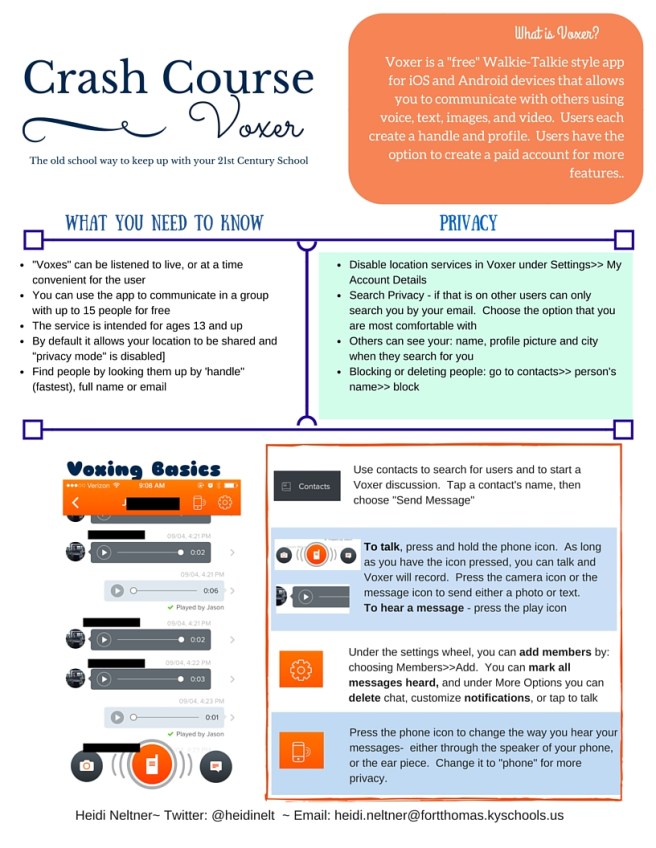
However, I recommend trying to use Voxer this summer so that, as you begin to scatter, you can still actively plan together. Yes, shared docs on a Google Drive can be products of this work, yet I think some of the best learning and ideas come from hearing each other’s voices and having time to process. You can add pictures, videos, comments, and more within the Voxer group. So as one person is on the beach, another cycling across Vancouver, and another hanging in their office, you can all stay connected. Below is an image I found that offers some basic Voxer101 information.
Full transparency, I have tried this before with mixed results. The people that jumped in and tried to leverage the tool found some success. With others, it was a mixed bag. And that’s alright. I know that if I didn’t make use of this then we would have hoped we were individually working on plans, and we would have spent time reading texts or emails or even sharing Google Docs. All of that is in isolation, right? My point is that there was no synthesis, no energy, and no excitement as an idea began to crystallize. How would we genuinely know we were sharing the best ideas and making them better? It would be a static experience right as we were seeking something dynamic.
I hope you’ll consider giving it a go. The added touch of voice matters.
What kind of tools are you using to ensure your off-season is highly productive? What other resources have you tried for collaboration?





 This year I have established the Mad Cool Awards. Focused on recognizing innovative work that is happening on campus, adults have the chance to recognize really cool stuff that is happening on their campus. Realizing that innovation is simply taking something that already exists and making it better, I ask them to complete a Google Form that asks just a few simple questions. And I consistently include the link to this form at the beginning of meetings and as an extra piece every so often within an email.



 For twenty years we have had a single lunch for our 3000 plus students. It’s one hour long and they can eat anywhere on campus. As visitors enter the building during lunch they are often taken by surprise as the students walk, talk, play guitar, study for quizzes and just hang out with their buddies. Many walk with a bag of chips in their hand as they socialize with new friends. At the same time in classrooms on each floor there are tutorials happening, clubs meeting, and teachers simply connecting with kids. The single lunch period absolutely provides the structures needed for students to be supported in all sorts of ways. Additionally, it has also built a culture where the students completely feel like their school belongs to them. They are trusted, they have agency, and they value it. And for nearly 20 years we kept it just like that. Check out this 2 minute student-created video about our one lunch
 My learning from this is two-fold. First I learned that subtle structures within a larger piece can bring strong advantages for kids and adults. Second I learned that even your most successful and “tried & true” school routines need to consistently be re-examined so that as you learn more, they can be improved. We should never slow down when it comes to learning about how powerful our school can be for kids.





 Exploring Leadership