You Got 8 Minutes?

For 12 years, every last Monday in September, I led a freshman parent meeting alongside my Dean of Instruction and Lead Counselor. We covered everything essential for both new and seasoned 9th-grade parents. As we wrapped up, I’d assign the parents homework. Specifically, they had to go home and ask their freshman this question: “If you were in a jam; if you were in a tough spot and needed help, who is the person on campus that you would go to?”

My point was that everyone on campus needed someone they felt they could go to. I didn’t care who it was; I only cared that they identified and said out loud who that person would be. It matters to say it out loud.
I recently listened to a Simon Sinek podcast How To Be A Friend with Chef Christina Tosi and I hope you’ll give it a listen. In particular, I was inspired by a few notions and found them relevant to so many relationships we have.

First, they explore the profound sense of honor that defines deep friendships. This isn’t just about the friends we’ve had since we were kids or the ones we share our workdays with; it’s also about those special ones who defy any easy label. The two of them then really dig into what it means to “sit in the mud together”—to share in each other’s struggles, ensuring that no one feels alone.

Additionally, I was also struck by the brainstorming they shared regarding openness and vulnerability in friendships. They argue that withholding our troubles from our friends, and denying them the chance to offer support, is more than just keeping to ourselves—it’s actually a form of disrespect. It’s a thought-provoking take that suggests staying silent and isolated might even be selfish. This perspective offers a fresh angle on the importance of vulnerability & mutual support in friendships. Something to chew on.

The second idea is the notion of 8 minutes. The podcast shares the research around the support one person can share with another. And it says that being present with another person for eight minutes can be all that is needed to help that person move forward. The problem may not be solved and more may be needed, yet it’s the idea that a mere eight minutes is sometimes all anyone needs. The podcast then shares Simon’s practice of reaching out to friends with a text simply asking, “You got 8 minutes?” From that brief exchange, action is merited, a connection is made, and the value of friendship is reinforced.

My challenge for you is to take time and identify who those 8-minute friends are. Then you must let them know the important role they play in your life. By acknowledging and including these friends, we not only show respect but also contribute to a sense of empowerment and companionship, potentially reducing feelings of loneliness and isolation for so many.


Default to Optimism

I was speaking with a friend the other day and we were rehashing the familiar challenges that come with the end of a school year. At the same time, there was a great change on the horizon for her work and she referenced that when learning about what may be coming, she found herself defaulting to the truth. This is an idea I first heard when reading Talking to Strangers, by Malcolm Gladwell. In short, the notion is that when meeting someone new or hearing something for the first time, most of us default to truth and the idea that what we are being told is honest. And possible.

Today marks 55 years since Bobby Kennedy was assassinated. And while I didn’t emerge on the scene until just over 12 months later, I have always heard of the promise that he brought to so many during an incredibly tumultuous time. He had his flaws and the scars he had earned certainly could have left him jaded, yet, from what I understand, he remained steadfast that our best days were still ahead.

While education and politics have certainly become more entangled, I remain optimistic that better days lay in front of us. I believe that the better argument in support of public education exists and it is our duty to find it and make it compelling to others. While I don’t know the full path forward, I do know that there are many people smarter than me out there grinding through all the noise, continuing to inquire and learn, and depending on all of us to sustain the needed effort.

For many years my default has been toward optimism and I’m grateful for the reminder of how buoyant we can become when offered hope.

Resources for Finding Community Pt 2

A couple weeks ago, I shared Resources for Finding Community Pt 1 with the hope that you could begin to find the connectors within your organization or team. Learning who the people are that have influence is the first step.

The next step is to begin to identify the characteristics of your community. Beginning with the premise of “when we are at our best….”, try using the questions below. These are a starting point for conversations that involve the senses. When I’ve used these in the past, I have found that small groups (mixed departments and roles on the campus/department/team) work best.

A community is always in transition – people come and go, priorities shift, and supplies can become scarce. Yet if members have reflected on who connects the pieces, what expectations they can have for their behavior, and how they can memorialize all they value, then the community has the best chance of surviving any disruption.

Try these out at your next opportunity and let me know what you learn.

Say Hello with Your New Summer Collaboration Tool

Each spring, campus leaders live in two worlds.  They are dually focused on all the annual testing amid the quickly approaching end of the semester and also building out the plans for the coming school year.  It’s terribly hectic while amazingly exciting.  And as schools head toward summer, I want to share a tool that I believe can help your team manage the next few months while avoiding the loss of momentum.

The most common questions from non-educators as June approaches are either (a) Do you have to work in the summer and/or (b) What do you do in the summer, just hang out? My polite reply is that summer is the off-season and that, similar to professional athletes, summer is spent both recovering from and preparing for the upcoming school year. Hiring of course is critical, yet planning is also paramount. Toss in the well-earned need for team members to simply vacation, and you can begin to see what can happen.  Finding time to gather and plan is tough. Yet I think there is a tool for you to consider.

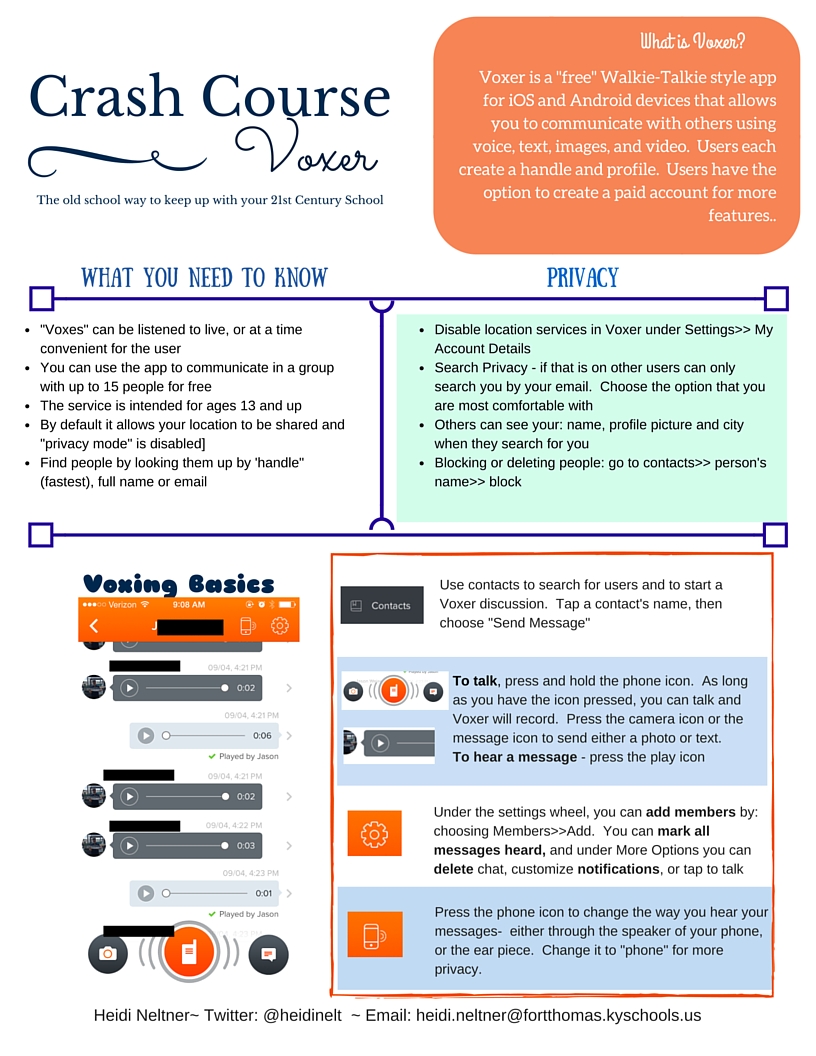
Voxer has been described as a sort of walkie-talkie for teams of almost any size. While that is fair, I think it holds even more power in the hands of a user. Unlike most walkie-talkie experiences, the users aren’t tied to be next to each other or close to a receiver/repeater. You can be anywhere with access to data.

Now I understand that you may be thinking that it’s unnecessary since your people on campus are – well – they’re down the hall.  You can already text them, and, you know where to find them, right?

Group Planning

However, I recommend trying to use Voxer this summer so that, as you begin to scatter, you can still actively plan together. Yes, shared docs on a Google Drive can be products of this work, yet I think some of the best learning and ideas come from hearing each other’s voices and having time to process. You can add pictures, videos, comments, and more within the Voxer group. So as one person is on the beach, another cycling across Vancouver, and another hanging in their office, you can all stay connected.  Below is an image I found that offers some basic Voxer101 information.

Voxer 101

Full transparency, I have tried this before with mixed results.  The people that jumped in and tried to leverage the tool found some success.  With others, it was a mixed bag.  And that’s alright.  I know that if I didn’t make use of this then we would have hoped we were individually working on plans, and we would have spent time reading texts or emails or even sharing Google Docs.  All of that is in isolation, right?  My point is that there was no synthesis, no energy, and no excitement as an idea began to crystallize. How would we genuinely know we were sharing the best ideas and making them better? It would be a static experience right as we were seeking something dynamic.

I hope you’ll consider giving it a go.  The added touch of voice matters.

What kind of tools are you using to ensure your off-season is highly productive?  What other resources have you tried for collaboration?

“This Might Not Work…”

I was listening to a podcast with Seth Godin as the guest and the discussion covered many topics, eventually landing around the ideas of “saying no” and “learning how to fail.” Seth goes on to share that as a teenager he started to employ the phrase “This Might Not Work” as he was introducing a new idea or strategy for action. And what emerged for me was inspiring.

In this time of accountability and school ratings (accompanied by the lack of patience), I think we can agree that mistakes have too often been stigmatized. Consequently, we shy away from trying something new or taking that bold step forward.

I learned that the power of the phrase – This Might Not Work – lies in how it sets expectations. Consider the two approaches below.

The former sets the responsibility at the feet of the person that originated the idea with the operational assumption that it will work. The latter makes clear that this may very well fail, and that we only move forward if the team wants to do it. One places the pressure, and possible joy, on a single person while the other permits the joy to be shared regardless of whether it works. Thus the fear of failure is minimized (if not removed). This is important if we want to be a part of creating anything original.

Think about it – we’ve all hatched an idea or shared in the development of a plan that we “never thought would actually work.” Or maybe the response was something along the lines of, “this might be just crazy enough to work.” Those memories usually include smiles and a nostalgic look back on the entire process. That’s the joy I am referencing.

I know that I’m going to try this out in my next planning meeting and I hope you’ll do the same. Let me know how it goes.

Reminder Outside Rockefeller Center

Service is black & white….hospitality is color. Getting the right dish to the right person (delivering the curriculum) is providing the service. When a connection is made, when a person feels heard and seen, then you are sharing hospitality. Add color and life and movement to the interaction & that’s what will be remembered.

In this episode of the A Bit of Optimism Podcast with Simon Sinek, his guest, Will Guidara, shares the story of a group of foodies that visited his 5 STAR restaurant in NYC. They gushed over all the wonderful meals they had enjoyed at the best restaurants in the city (and in the world). One of them then remarked that the only thing they had not had in NYC was a “dirty water” hot dog. Specifically, for anyone that has not enjoyed this delicacy, a “dirty water” hot dog is bought from a vendor on a street corner in Manhattan. So Will overheard this comment, rushed out to the corner vendor, and purchased a hot dog. He then had it served in an elegant fashion, and the table of foodies was amazed. Their experience escalated to unforgettable and they now had a story to tell friends for years.

The big takeaway for me from the episode was that when unreasonable hospitality is experienced, either personally or as a witness, the release of oxytocin and other “feel good” chemicals is the same for both the recipient AND those that witness it. In essence, it is the brain teaching us that being kind to others, whether hearing a story of kindness or witnessing generosity, makes us feel better. I mean, think about the TikTok videos or reels that touch your heart – and we are merely a witness to them. Small moments can inspire big notions to perform something similar for another.

It makes no difference whether we are in the restaurant business or the education profession, we always have the chance to add color to someone’s life. Often we merely need to slow down, listen, and then leap. And while our attempt/success rate may not be as high as we wish, there is never a shortage of opportunity. Strive to be deliberate. Moments matter.

5 Coaching Questions

I have to admit that, for a short time each day, I’ll watch TikTok. In addition to some incredibly creative videos, there is quite a bit that can be learned. Of late, I have stumbled on to @Askvinh – a resource that either affirms practices that I’ve tried or inspires new strategies to use. If you aren’t familiar with him, then I would encourage you to check him out. Some good stuff there.

An important element for any leader to learn is how to coach someone that has a dilemma. Often we default toward consulting, wherein we give them specific advice to move forward or solve a situation. And sometimes that’s what is needed and is completely appropriate. The more challenging piece for both members can be a coaching scenario. This is where the leader helps someone reach their own conclusion. It is harder, takes more time, and can lead to frustration. I think these five questions from an @askvinh TikTok can help & I’m eager to share them.

  1. What’s on your mind? This opens the door for anything and avoids the trap of embarking on the conversation from a specific mindsight. So instead of asking, “What’s wrong?”, which can set a tone of discontent, you are expressing to this partner that you have an open mind and are available for whatever might emerge.
  2. What else? This allows the speaker to share everything they want with your permission. They can empty the tank.
  3. What’s the challenge? This focuses them on the obstacle or hurdle that seems to be in the way. You are giving them the opportunity to define this which takes it from a “soft or gooey” state to something more specific, more objective.
  4. What do you want? This forces them back toward a solution. Essentially, you are pointing them forward and it remains personal. This is still about them.
  5. What can I do to help? This is where you learn whether you need to offer a specific set of next steps or if they feel confident to move forward. Either way, you have helped.

It’s not uncommon for people to elevate to leadership positions based on individual accomplishments. Sometimes the resulting personal struggle revolves around the development of management muscles. And at the same time, we are mentored to strengthen our leadership potential by becoming active listeners. I totally agree with a commitment to that skill.

Through my exploration of leadership, I have come to the conclusion that we can more explicitly develop leadership in others through the questions we ask. I believe those five questions are effective, and I encourage you to try them in your next conversation. Let me know how it works.

Coaching Teachers Without Asking Why

At the end of last school year, one of the areas of learning that our faculty/staff identified was feedback.  Teacher to student, student to student, leadership to teacher, etc.  The campus wanted to learn more about how to offer feedback that was useful and could be leveraged for improvement.  Having this focus enabled me to return to some training I had received years ago based on the work of Carolyn Downey and the 3-Minute Classroom Walk-Through.  Click here for a strong description.

So what I find most valuable from the Carolyn Downey work is the reflective question.  Essentially, the idea is that after you complete your walk-through, either via email or a planned “bump into”, you share what you observed and then leave them with a reflective question.  Follow that with built in time for them to reflect on it.  Perhaps you tell them you’ll check back in later.  Or simply leave it open-ended.  The purpose is to have them reflect.

John Dewey

I find this most powerful when I focus on a decision that they made.  Perhaps its the strategy they used to check for understanding; or maybe its a choice they made to use segments of a video; or merely directing students to either work independently or collaboratively.  The point is that they select their next steps, they consciously decide to do something.  For many it is muscle memory.

I strive to ask the question in a manner that focuses them on an instant – a decision point.

“When you decided to have the students work collaboratively on the lab, what outcomes were you striving to achieve?”

“How do you think your lesson would have gone for the students if they had been provided guided notes for the video you showed?”

“When introducing a new concept, what do you consider when choosing a formative assessment tool or strategy?”

Each of the questions above works from a premise that they were fully prepared and thoughtful with the questions they asked, or the lesson they designed.  It then moves from there to a choice they made and asks them to reflect on it.

Could I have sought the same information by simply asking “why did you have them work with partners?” or “why did you or didn’t you provide guided notes?”  Maybe.  That’s certainly more direct.  However the word “why” is incredibly powerful.  Generally speaking, it leads the receiver of the question to take a defensive position.  And that is the last thing I want to do when building rapport for feedback.  Asking “why” can lead them to narrow their thinking just as I want them to expand it.

baby pondering

As you work toward having teachers understand the effects of the decisions they make, of the plans they develop, what strategies do you employ?

What would it look like for you to not use the word “why” for the next week with your students or your staff?

Saying & Hearing Thank You

Early on in my career, I was encouraged to keep a box near my desk.  You know, a receptacle for all the letters and cards and words of encouragement that would surely come my way. And as I made my way through that first month, and then that first semester, I began to wonder if my small shoe box was too lofty of a goal.  Or perhaps I simply wasn’t connecting with my students as I wished.  Finally, on a piece of green construction paper, 7th grader Robin had glued a handwritten letter offering me praise for simply not giving up. Those words helped me keep my footing through the winter break, survive the tough February days, and launch me toward the summer.  Twenty-five years later and I still have that letter. However I have outgrown the shoe box and find myself filling a nearby desk drawer dedicated to these positive messages. Not only does the drawer remind me of my better moments, days, months and years.  It also reminds me to take the time to share positive words with others.  black-shoeboxA challenge I had to overcome was allowing myself to simply receive the compliment.  Too often we deflect and say something like: “oh, it was my pleasure”, or “no, you are the one I should thank.”  When we do that we steal from them a small piece of the joy they have for us.  We rob them just a bit of the power that comes with recognizing another.  I would recommend that, instead, we simply say, “Your words mean a lot.  Thank you for taking the time to share them with me.”  I know this is easier said than done however I have learned that those few words carry more power.

world-is-giving-answers

Becoming friends on social media with former students can be another way to remain connected while also serving as a reminder that you had an impact on their life.  When someone chooses to include you in the minutiae as well as grand moments in their life, they are telling you that you matter. And as I engage in pictures, videos, and stories of their emergence into adulthood, those beaming moments around marriage, the celebrations of becoming a parent, I am quickly reminded of my impact.  And I work hard to give it all the space to breathe.

thank-you-post-it_languagesSo as you sustain your effort through this fall semester and look toward the grind of the early spring, I hope that you will remember the power you have each day to positively impact a young person.  Regardless of whether or not they find the right words to thank you, I am certain they appreciate what you do each day.  Perhaps they will write a nice card or draw you a picture. Or maybe they will come in one morning to share something amazing their family did over the weekend. Or it will be a simple smile they offer, a “thanks” on the way out of class, or a nod in the hall. Regardless of the form it takes, work hard to not miss it.  Because you are significant and they want you to know it.


How are you making sure that you are showing gratitude for others while also being able to receive it?

Be Loud & Be Proud

Not long ago I had the chance to hear Joe Sanfelippo talk about how each school must be willing to tell their story.  I’ve heard Joe share this discussion more than once and each time I take something different away from it.  That’s how it usually is, right?  Like a great book or movie, we learn something new with each experience.  Now I want to focus on one particular communication tool we have used for the past 5 years and I’m hopeful it can be of value to other schools either now or for the coming school year.  This event helps us tell our story and we call it Cardinal Kickoff.  The premise centers on the idea that we want to open our doors and show you everything that makes us #CardinalProud.

The description that follows is not a prescription or recipe, rather an example of how a school can take assets that already exist and organize them in a purposeful manner.

TYS Big

Cardinal Kickoff begins with parents arriving and finding our advanced guitar students playing in the auditorium foyer.  And as families grab a program and find a seat, there is a PowerPoint playing with pictures and quick facts cycling and a small string quartet sharing a few pieces.  This large group general session involves a 30 minute presentation focusing on the academic life, the means by which we communicate, and the various ways that kids can get involved on campus.  It’s mostly me talking with some short mixed media pieces to help inform.  The session ends with an introduction to the spirit within our school as led by our Cheerleaders.  As they teach the Color Shout to our future Cardinals you can feel the energy begin to climb within the room.  What follows is my favorite part.

Cardinal Kickoff Big

Students and families head to the cafeteria down hallways flanked with our jazz band playing.  And as a little pep enters your step, students can begin to see and hear the buzz inside.  Filling every corner of this large space are tables packed with posters, treats, memorabilia, and sign-up sheets. The room is filled with electricity powered by current students who are recruiting with the same zeal as a basketball scout that has just found the next Lebron James.  Prospective families make their way through the crowds, moving past the Robotics booth to the South Asian Student Union.  They grab a cookie from the Baking Club and enjoy the Anime Club videos.  Music blasts from a corner area with eMotions dancers in a freestyle break-dance session.  Finally they cruise past the Swimming and Lacrosse tables to find the Chess Club.  And each year as students leave the cafeteria, catching up with mom and dad, I often hear something along the lines of, “this school really does have everything.”  Cardinal Kickoff allows us to show off the student life that exists on campus, an element that fully complements our academic program.  The student life portion of the high school experience is alive on our campus.  As a staff member said the first year as the event closed – we are big, we are loud and we are proud.

I share all of this as an example of how we try to tell our story.  And as I reflect on the event, I offer another conclusion that I have reached – one that might be even more important.  I have learned that while I thought we were telling the story to families on the outside, the most ardent consumers were the students and staff within the building.  You see, for many of them this was a chance to learn themselves about all that we offer.  Students were finding out that we had all these programs, and these opportunities, and that made them proud.  And they began to share that same story to others on campus.  And the resulting energy, excitement, and enthusiasm have been the greatest rewards.

Microphone wide

Telling your story doesn’t just benefit people that are looking for the best school.  Deciding to share all that makes you proud is just as important to those already on the inside.  Stories teach us and they also remind us.  They have the power to get us through the toughest times in the spring semester and they can propel us toward the fall.  Momentum can spring from telling your story.  It doesn’t matter if you share it with a microphone in your hand or while standing in line at the grocery store.  The point is that you are the only person that can.  I hope you’ll consider the power of your school’s story and commit to start telling it today.