
A couple years ago, I committed to exploring leadership with this blog. I think I’ve been pretty good (maybe a B-) about doing that though I’m trying to be more consistent with my own learning (and then sharing it). This post is a direct result of that.
I recently listened to an episode of Simon Sinek’s Podcast – A Bit of Optimism https://simonsinek.com/discover/episode-35-raising-resilient-kids-with-angela-duckworth. Truthfully, I’m a bit hooked right now. The episode had Angela Duckworth as the guest, so you would expect that the idea of Grit emerged. And while it did, there is a different aspect that resonated with me. And I think it absolutely is an extension of leadership, specifically building leadership in others.
During the conversation between Simon & Angela, there is a brief mention of Alcoholics Anonymous (AA) and how it works. I did not know this yet it was revealed that the data points toward the conclusion that even if someone masters the first 11 steps, if they fail to accomplish step 12, then they have a very high likelihood that they will succumb to the disease once again. The 12th step – help another alcoholic. Essentially “help someone else with the thing they are struggling with.”
There is an inner need within us all to be significant. In moments where we are struggling, having the chance to act in a significant way for another is often exactly what we need to begin to turn a corner. I believe this can also work as we build leadership in others. Purposely seeking out opportunities to ask for advice or input from an aspiring leader allows them to contribute. And by reflecting and offering their words, they often walk away having gained more from the experience than you.

To be clear, this is not limited to adults. In my more than three decades of working with young people, I often found that struggling students can begin to prosper when they are asked to help another. Being trusted by an adult is powerful and builds assets within that young person at the first moment. Honestly, I wasn’t always aware enough to act on this wisdom as too often I employed the “usual kiddos.” That was a missed opportunity and I needed to be better.
Finally, it is the act of committing ourselves to each other that also leads toward the further development of a community. I talk about this in a previous blog regarding Everyday Leadership Who Doesn’t Like a Lollipop?. I would challenge you to be purposeful the next time you have the chance to enable someone to be significant to another. A tiny shot of “I believe you can do this” or “I need your help/insight/wisdom with this” can go a long way.
So who comes to your mind right now? And how will you act on that tomorrow?









 Later she contrasts excuses vs reasons and I found this compelling for educators. Too often I think we offer, or at least entertain, excuses because that is often the path of least resistance. It’s always easier to look for a culprit rather then to look for a path forward. The students she spoke with seemed to understand that stuff happens. And when you opt to ask questions then you can reflect. And when you commit to reflect you find a solution or a next step. It is the act of choosing – making a decision – that matters.


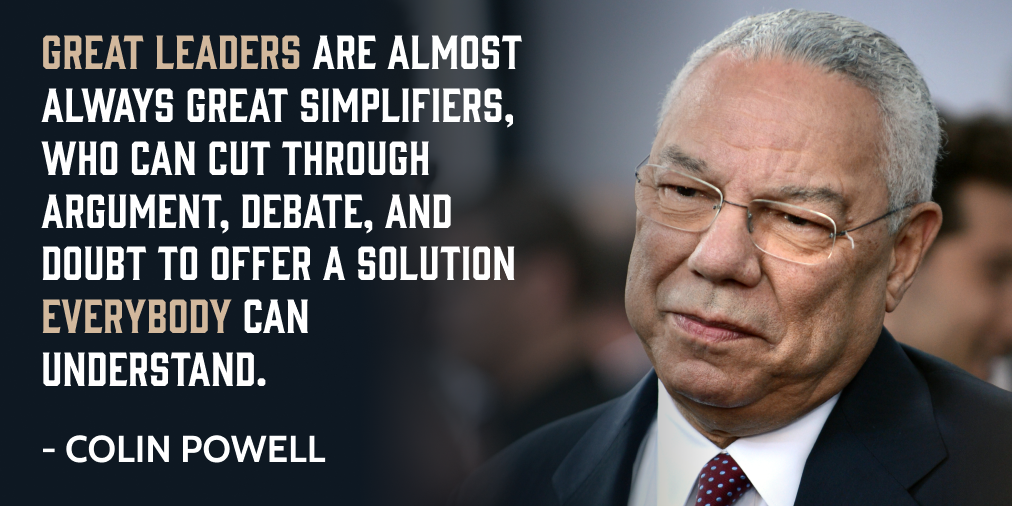 Each time I read this quote from Colin Powell, I find myself drawn to the idea of how a leader can hear many different ideas and narrow down the focus to a simple idea or two. I work hard on this trait as a campus leader myself – sometimes with a focus on a solution and other times only on finding common agreement.


 I am drawn to the idea of Ambiguity being the same as inexactness. And the gray is where we often attribute the idea of being open to more than one interpretation. So much of what we do as leaders lies in the contrary. I understand the discomfort with not always knowing when so much is at stake. I get that it is hard and challenging, and you may not understand for a long time whether your choice was the best one. That small undefined area, that sliver of mystery, is where the strongest leaders have the chance to emerge. To thrive.
 The challenges that kids face nowadays far exceeds my greatest dilemmas. I suspect that is true for most of us. I wrote about this in one of my first blog entries a couple years ago
  Exploring Leadership