
What Are You Becoming?

The Boston Marathon was the other day, and I had two friends running it. They were excited to be back, especially for this 10th anniversary. And as I settled in to watch the TV coverage, and track them on the app, I kept hearing the announcers talk about individual runners. And they would refer to them by their best times. “That’s a 2:03 guy” & “She’s a 2:25 runner”. They were identified based on a static moment in their running history. As if that’s all there is to them. Hmm.

Nearly three months ago, I retired from public education. And my first day in this new adventure, I did what I thought most retired people do – I went to the mall and walked around. It’s amazing how much quieter it is on a Wednesday. I’m not sure what I expected to find that late morning, perhaps a sense of new purpose….or merely the best place to get frozen yogurt or a fresh cookie. Discovering the usual suspects slumped in chairs and across benches, I wondered if this was my new #squad. I’m far too spry for all this, right? And as I traversed the food court and circled back behind the carousel, a billboard sign caught my eye.

Eliud Kipchogee is the greatest marathoner of all time, and he often shares the notion that no human is limited. From that, I believe he is affirming that we are all on a journey forward; on a path toward more. When we slow down and consider that we are each in the dynamic state of becoming – that we are existing in the place between what has been and what will ultimately be – then maybe we can find the grace & patience that we all deserve. Whether a student in your class, a client for your firm, or a friend that may challenge the relationship, we are all still under development.

And thus it begs the question – What are you becoming?

The Need to be Significant

A couple years ago, I committed to exploring leadership with this blog. I think I’ve been pretty good (maybe a B-) about doing that though I’m trying to be more consistent with my own learning (and then sharing it). This post is a direct result of that.

I recently listened to an episode of Simon Sinek’s Podcast – A Bit of Optimism https://simonsinek.com/discover/episode-35-raising-resilient-kids-with-angela-duckworth. Truthfully, I’m a bit hooked right now. The episode had Angela Duckworth as the guest, so you would expect that the idea of Grit emerged. And while it did, there is a different aspect that resonated with me. And I think it absolutely is an extension of leadership, specifically building leadership in others.

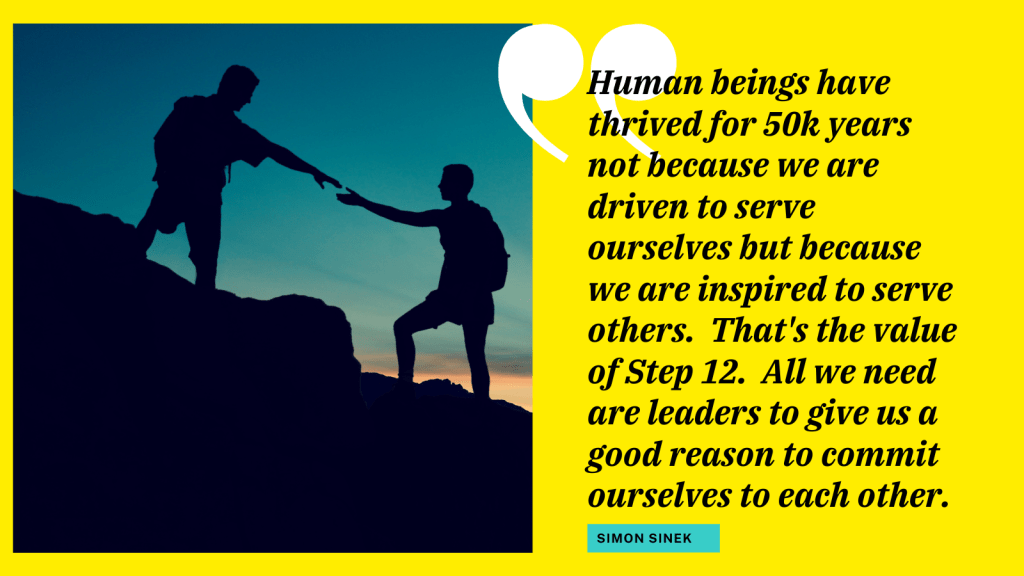
During the conversation between Simon & Angela, there is a brief mention of Alcoholics Anonymous (AA) and how it works. I did not know this yet it was revealed that the data points toward the conclusion that even if someone masters the first 11 steps, if they fail to accomplish step 12, then they have a very high likelihood that they will succumb to the disease once again. The 12th step – help another alcoholic.  Essentially “help someone else with the thing they are struggling with.”

There is an inner need within us all to be significant. In moments where we are struggling, having the chance to act in a significant way for another is often exactly what we need to begin to turn a corner. I believe this can also work as we build leadership in others. Purposely seeking out opportunities to ask for advice or input from an aspiring leader allows them to contribute. And by reflecting and offering their words, they often walk away having gained more from the experience than you. 

To be clear, this is not limited to adults. In my more than three decades of working with young people, I often found that struggling students can begin to prosper when they are asked to help another. Being trusted by an adult is powerful and builds assets within that young person at the first moment. Honestly, I wasn’t always aware enough to act on this wisdom as too often I employed the “usual kiddos.” That was a missed opportunity and I needed to be better.

Finally, it is the act of committing ourselves to each other that also leads toward the further development of a community. I talk about this in a previous blog regarding Everyday Leadership Who Doesn’t Like a Lollipop?. I would challenge you to be purposeful the next time you have the chance to enable someone to be significant to another. A tiny shot of “I believe you can do this” or “I need your help/insight/wisdom with this” can go a long way.

So who comes to your mind right now? And how will you act on that tomorrow?